
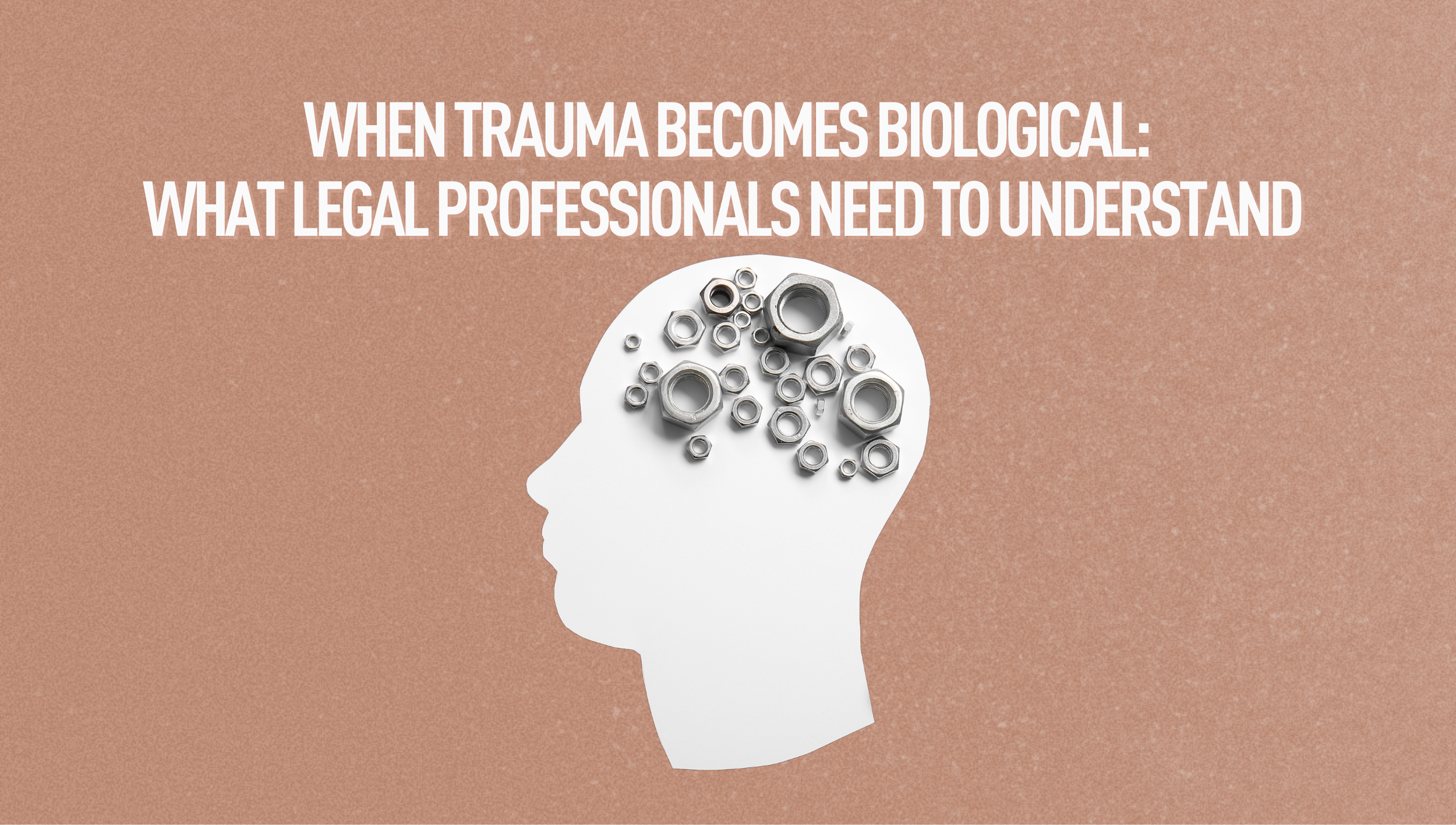
There is a growing body of research confirming trauma does not begin and end with the individual who experienced it. It can be carried biologically, relationally, and behaviorally into the next generation.1
Not as a life sentence. But as a starting point.
Why This Matters in Legal Practice
As legal professionals, we are trained to focus on facts, timelines, and individual responsibility.
And yet, when a client presents as:
- reactive
- shut down
- inconsistent
- or “difficult”
…it may not be willful behavior.
It may be a nervous system shaped by experiences that predate them.
Emerging science in epigenetics shows that trauma can influence how genes are expressed—particularly those involved in the stress response. This means some clients arrive in our offices already carrying heightened sensitivity to threat, stress, or authority.
Not because they are broken. Because their system adapted.
What we often label as:
- noncompliance
- avoidance
- emotional volatility
can be understood instead as adaptive survival strategies.
These adaptations may have roots in:
- parental trauma exposure
- stress during pregnancy
- early caregiving environments shaped by unresolved trauma
From a nervous-system perspective, the question shifts from:
“What’s wrong with this client?” to “What has this client’s system learned to expect?”
Trauma can echo across generations through:
- biology (stress-response patterns)
- behavior (attachment, communication)
- environment (chronic stress conditions)
And importantly, so can regulation, safety, and repair.
The research is clear: these patterns are not fixed.
Supportive relationships, predictable environments, and trauma-informed interactions can:
- reduce stress reactivity
- increase capacity for regulation
- interrupt cycles of harm
What This Means in the Justice-Seeking Experience
You are not being asked to become a therapist.
But as a legal professional, you are in a position to either:
- reinforce a client’s sense of threat or
- become part of a different experience of the legal system
Small shifts matter:
- clarity over complexity
- predictability over surprise
- choice where possible
- tone that signals respect, not urgency or alarm
These are not “soft skills.” They are neurobiological interventions.
A Trauma-Informed Reframe of Legal Advocacy
When we understand that trauma can leave biological traces, we begin to see:
Your client’s behavior is not random. Their reactions are not personal. Their capacity is not fixed.
And your presence, your pacing, your language, and your structure can either escalate stress or support regulation.
Closing Invitation
You don’t have to overhaul your entire practice.
You can begin with a single question:
“How might I adjust my approach if this client’s nervous system is already carrying more than I can see?”
That question alone has the power to shift outcomes not just legally, but humanly.
We invite you to take our Trauma-Informed Law Training delivered by Christy Heiskala.
Christy Heiskala is a credentialed survivor advocate and trauma informed law specialist on a mission to change the justice-seeking experience. She trains legal professionals how to differentiate their law practice and transform client experiences. Her Trauma-Informed Law Training helps you understand the science behind human behavior under stress, and offers practical, accessible tools to support your clients and your team more effectively.
Source: 1) scientificamerican.com/article/how-parents-rsquo-trauma-leaves-biological-traces-in-children/